
Home
Resources
Case Studies
Pléiades Neo
Monitoring roof health over ti...
Monitoring roof health over time with Pléiades Neo
Challenge
Today, to understand a roof’s condition, professionals mainly rely on two methods:
- on-site inspections which are slow, expensive and risky (falls from height remain a leading cause of serious accidents in construction - < 60% accidents occur during roofs inspections – source: OPPBTP 2024)
- drones, which require specific authorisations, insurance and in-house skills
Insurers and asset managers must monitor a building stock that is degrading faster due to climate stress while water damage is already one of the top causes of home insurance claims.
Every year, a significant share of buildings make claims for water damages or leaks that cost on average €10–15k per major roof-related claim.
A poorly maintained roof can lose 5–10 years of lifespan compared with a roof that is regularly inspected and repaired.

Two main challenges:
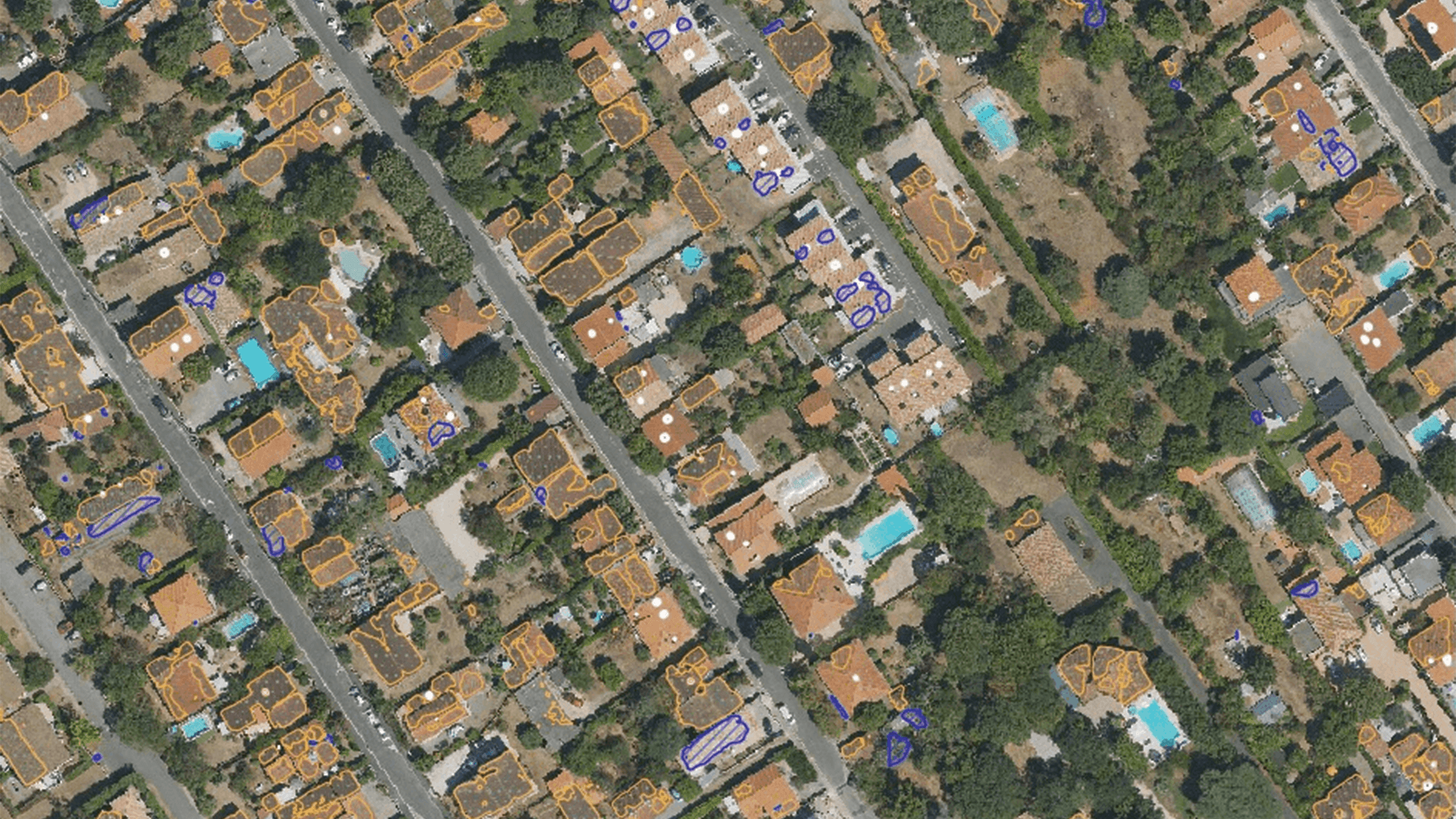
- BIRDIA uses these Very High Resolution (VHR) aerial orthophotos (5–7 cm/pixel) to produce an automatic roof diagnostic.
- But between two aerial campaigns, tens of thousands of roofs on a territory can degrade.
- Therefore, the first challenge is to keep the precision of VHR aerial imagery for the reference diagnostic.
- The second challenge is to add regular refresh at city or portfolio scale without relying on frequent new aerial flights.
What about using public aerial imagery?
Local authorities own ultra-high-resolution aerial orthophotos at 5–7 cm/pixel which are extremely precise but updated only every 2–3 years because each refresh requires a new aerial campaign.

Analyse a roof in depth on VHR aerial imagery (5–7 cm/pixel): roof and roof-facet segmentation, 3D reconstruction with HD LiDAR, characterisation of coverings, wear patterns, ponding, obstacles and solar potential.
Call OneAtlas to retrieve the latest available imagery and project the analysis reference diagnostic onto Pléiades Neo/Pléiades Neo HD15 satellite imagery for the same building.
Compute a “mutation” score of the roof state between dates: degraded (new dark zones, moisture traces, material loss, changes in texture or reflectance), repaired (homogeneous new covering, disappearance of previous defects, new materials, spectral change consistent with renovation), stable (no significant change beyond a defined threshold).
Benefits
Automated monitoring of tens of thousands of roofs per year where a human expert can only inspect a few dozen per week.
Fewer climbs onto roofs just to “have a look” and therefore fewer falls and accidents.
Roofs maintained on time can gain several extra years of service life, limit water ingress and reduce energy losses through the building envelope.
Early detection of roofs at risk before claims occur, better prioritisation of site visits and labor cost.

Organisation involved
BIRDIA provides advanced AI-powered diagnostics and monitoring services for roof health leveraging ultra-high-resolution aerial imagery and satellite data. By combining 5–7 cm aerial orthophotos with Pléiades Neo satellite refresh, the company enables large-scale roof inspections, change detection and risk assessment across entire cities or asset portfolios.
Founded in France, BIRDIA supports roofers, insurers and public authorities with scalable tools that reduce site visits, prevent water damage and extend building lifespan. With its hybrid approach of deep learning and expert rules, BIRDIA is helping professionals shift from reactive maintenance to predictive asset management.
Did you find what you were looking for?
Speaking with the Airbus team is the best way to get started.