
Home
Resources
Case Studies
Pléiades Neo
Scaling urban climate intellig...
Scaling urban climate intelligence with Pléiades Neo imagery
SIRADEL uses very high-resolution satellite data and AI-powered digital twins to model and anticipate urban microclimates at city scale.

LCZ classification by SIRADEL - city of Amman, Jordan. © Airbus DS 2023
Challenge
Support communities build climate-resilient cities leveraging very high-resolution satellite imagery.
Climate deregulation requires cities to understand and anticipate urban meteorological phenomena. Microclimates - urban geat islands, waterproofing, greening gaps - are set to increase over the years, all of which will directly affect climate resilience, public health and urban planning. These challenges are relevant to a wide range of sectors, including local governments, urban planning, environmental consulting, infrastructure and climate adaptation.
Traditional means of environmental urban diagnosis
For years, microclimate predictions and understanding were done through aerial imagery and ground-based measurements. However, this traditional approach presented three major limitations:
- Limited scalability across territories
- No regular refresh that are needed to monitor rapidly evolving urban environments
- Limited view of how urban microclimates change over time
These limitations create a major gap between the growing need for detailed environmental diagnostics and the practical limits of traditional data acquisition methods.
Orignal Pléiades Neo satellite imagery of an area in Vancouver. © Airbus DS 2022
Solutions
Supported by Airbus and CNES, SIRADEL produces digital land use (DLU) and local climate zone (LCZ) models using Pléiades Neo satellite imagery.
To make urban microclimate analysis more scalable and easier to update, SIRADEL fine-tuned its urban segmentation model, DLU UrbanMaps, to work with very high-resolution satellite imagery from Pléaides Neo (30 cm) and HD15 (15 cm). This allows the company to move beyond dependance on aerial imagery while maintaining a high level of detail for urban analysis. The solution combines several processing layers.

Digital land use derived from Pléiades Neo imagery data using a predictive AI model
Generating land cover classes through advanced AI models
Semantic classification is used to generate 12 land-cover classes, providing detailed understanding of urban surfaces such as buildings, vegetation, roads and other materials that influence local climate behavior.
Use very high-resolution satellite imagery to derive digital elevation models (DEM)
30cm stereo image pairs are used to derive a consistent DEM and extract level of details 1 (LOD1) building outlines as well as key morphological parameters, which are critical for characterising urban form.
AI object detection
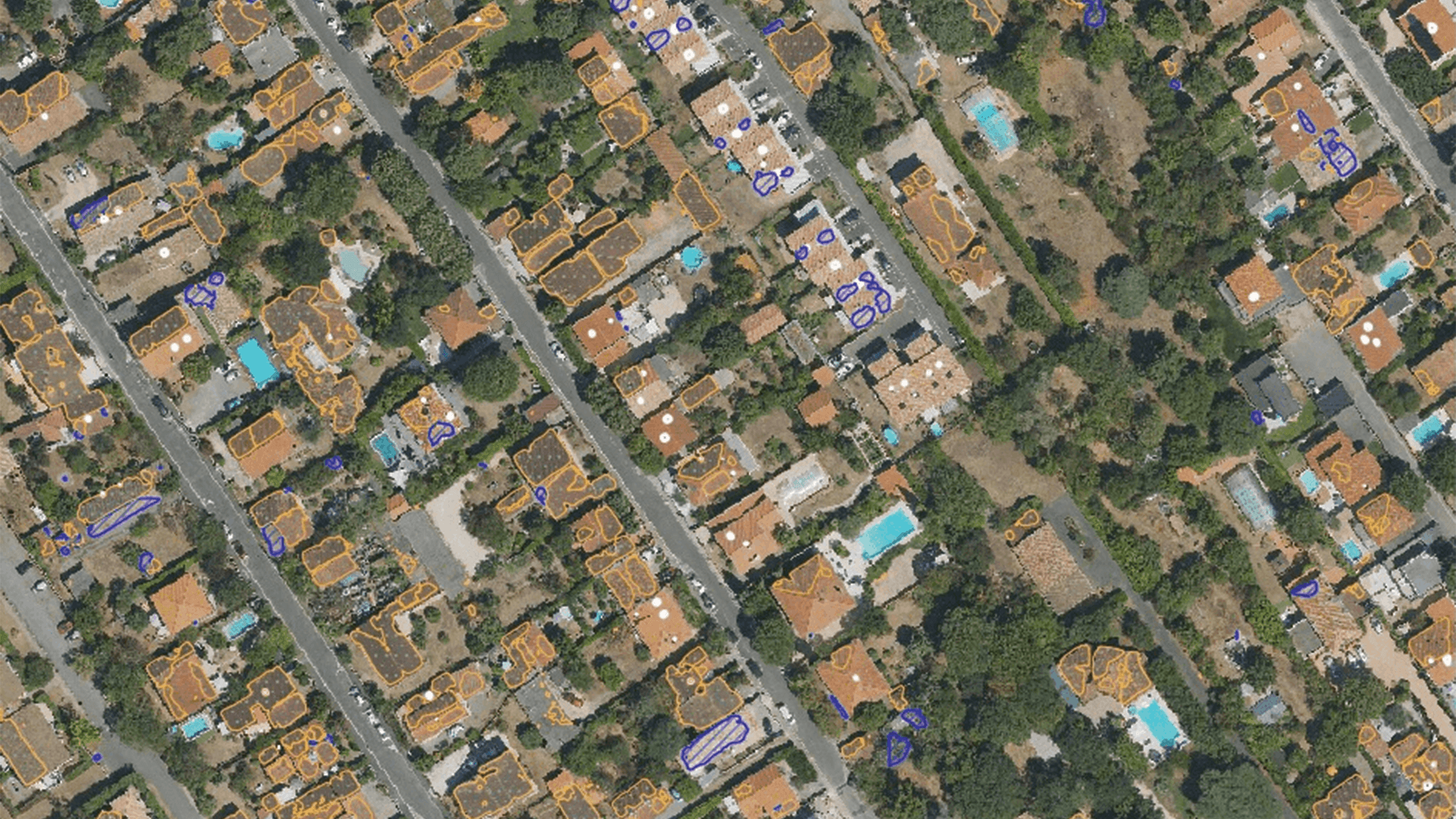
AI-based object detection is applied to improve the precision of building footprints, a key requirement for reliable local climate zone classification.
Active learning for other cities
Active learning is used to improve model generalisation when deploying the solution in new cities, reducing the need for extensive retraining.

Land climate zone classification – building divisions made with AI model from Pléiades Neo imagery

Level of details 1 (LOD1) generated from Pléiades Neo data

Trial in Vancouver
A concrete production run over 48.7 km² in Vancouver demonstrated that Pléiades Neo imagery can accurately capture fine urban structures. In this case, LCZ classification performance reached 77% under strict evaluation metrics and 96.8% with tolerance, which is close to the performance typically achieved with high-resolution aerial imagery.
SIRADEL models allow planners to assess urban development projects at the design stage, compare alternative scenarios and challenge their relevance and feasibility before implementation.
Overall, the project empowers cities to make more infrared, forward-looking urban planning decisions by turning complex environmental data into actionable insights thanks to Pléiades Neo satellite imageries.

Original Pléiades Neo Satellite imagery of an area in Vancouver. © Airbus DS 2022

Land climate zone classification derived from Satellite imagery data through SIRADEL AI model
Benefits
Scalability
Satellite imagery enables consistent analysis across large territories and multiple cities, overcoming the geographic and logistical limits of aerial data collection.
Resolution and global coverage
Pléiades Neo provides a high level of details compatible with urban environmental diagnostics, while offering worldwide accessibility.
High update frequency
Regular satellite revisits allow cities to track urban changes and evolving microclimate patterns over time, rather than relying on one-off datasets.
Cost efficiency at scale
Compared to repeated aerial surveys, satellite imagery significantly reduces acquisition costs, especially when deployed over large areas or multiple projects.

Organisation involved
SIRADEL designs 3D digital twins and geospatial solutions for land analysis. The company aims to support the growing needs in connectivity, climate resilience and urban planning.
To achieve this, the company develops advanced AI models, coverage simulation tools and collaborative platforms to help local authorities, operators and industrials build sustainable territories.
Customer testimonial
The operational availability of Pléiades Neo imagery has made it possible to quickly obtain very high resolution data, ideal for characterising materials and surfaces contributing to urban overheating phenomena.
Laura Frouin
Project manager - Spatial intelligence and climatic resilience
Did you find what you were looking for?
Speaking with the Airbus team is the best way to get started.